
CMS Care Delivery Readiness: What Will Be Penalized Before CMS Ever Says So

Over the past year, CMS has delivered one of the clearest directional signals in decades about the future of care delivery. Through ACCESS, LEAD, MAHA ELEVATE, the elevation of Advance Care Planning, expanded interoperability expectations, and AI-enabled utilization management pilots, CMS has defined a new operating baseline.
What CMS has not done is publish a list of penalties.
That omission is intentional.
Historically, CMS does not begin transformation by issuing enforcement threats. It begins by changing assumptions. Organizations that fail under new models rarely fail because they miss a specific measure. They fail because their operating model cannot meet expectations CMS quietly assumes are already in place.
This is the phase the industry has now entered.
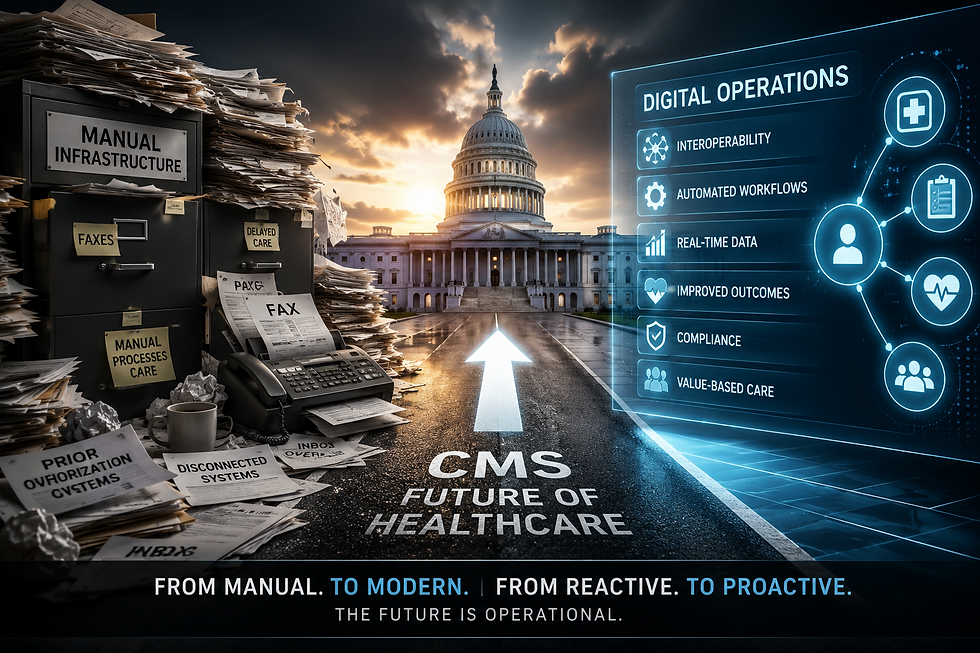
CMS care delivery readiness is becoming the silent dividing line between organizations that compound performance and those that experience rising friction, volatility, and eventual underperformance.

What CMS Care Delivery Readiness Actually Means
CMS is no longer testing whether value-based care works. It is standardizing what it believes competent care delivery organizations should already be able to execute.
Across current and emerging models, the assumptions are consistent:
Care is longitudinal, not episodic.
Accountability follows the person, not the facility.
Decisions must be explainable and auditable.
Patient intent is expected to influence utilization, not simply explain it after the fact.
CMS care delivery readiness refers to whether an organization’s infrastructure, workflows, and governance can support those assumptions at scale.
Organizations that cannot will struggle even while remaining technically compliant.
How CMS Penalizes Unreadiness Without Saying So
CMS rarely starts by cutting reimbursement. It starts by altering the conditions under which success is possible.
The earliest penalties of unreadiness tend to show up as operational consequences:
Administrative cost rises faster than outcomes improve.
Attribution leaks across settings without clear accountability.
Audits expose gaps between intent and action.
Staff burnout increases as coordination remains manual.
Utilization patterns become volatile and difficult to manage.
These are not isolated execution problems. They are structural signals that the operating model no longer aligns with CMS expectations.
By the time formal penalties arrive, competitive position has already eroded.
Failure Mode One: Intent That Exists but Cannot Shape Decisions
Advance Care Planning and patient priorities are being elevated across multiple CMS programs. But CMS is not rewarding the existence of documentation. It is assuming intent can function as an operational input.
The first failure mode CMS care delivery readiness exposes is intent that exists but cannot be used.
Common examples include preferences documented but unavailable during transitions, goals discussed but invisible during utilization decisions, and ACP completed but trapped inside a single EHR instance.
In these scenarios, organizations can prove conversations occurred but cannot prove care aligned over time.
As CMS moves from “did you ask” to “did care actually align,” this gap will quietly degrade performance through avoidable utilization and misaligned interventions.
Failure Mode Two: Coordination That Depends on Heroics
CMS models increasingly assume care coordination is routine, not heroic.
Yet many organizations still depend on individual memory, informal handoffs, spreadsheets, and tribal knowledge of payer or provider behavior.
That approach does not scale.
CMS care delivery readiness assumes coordination is systematic, auditable, and resilient to staff turnover. Organizations that rely on heroics may survive pilots. They do not perform under longitudinal accountability.
The penalty here is fragility, not a line-item reduction.
Failure Mode Three: Data That Arrives Too Late to Matter
CMS has been explicit that interoperability is no longer aspirational. Data must move.
But the deeper issue is not access. It is timing.
Data that arrives after decisions are made supports reporting, not care. CMS care delivery readiness assumes data functions as a real-time operational input that can shape decisions before utilization hardens.
Organizations that cannot act quickly enough will fail to meet outcome expectations even with strong analytics.
Failure Mode Four: Automation Without Governance
AI is entering utilization management, prior authorization, and care management workflows. CMS is not endorsing black-box automation. It is testing whether AI can coexist with accountability.
Automation without auditability, explainability, or escalation logic will create risk, not advantage.
CMS care delivery readiness assumes AI augments judgment rather than replaces it. Organizations that deploy AI as a bolt-on will encounter resistance, scrutiny, and performance volatility.
Failure Mode Five: Accountability That Stops at Organizational Boundaries
CMS models increasingly span acute, post-acute, home-based, and senior living environments.
Yet accountability often stops at the facility or contract boundary.
CMS care delivery readiness assumes responsibility follows the person across settings and over time. Fragmented accountability will become a liability even if individual components perform well.
What Leaders Should Be Doing Now
The most dangerous posture is waiting for explicit enforcement.
Leadership teams should instead examine where intent fails to influence decisions, where coordination relies on individual effort, where data arrives too late, and where accountability breaks across transitions.
Those gaps will define performance long before CMS names them explicitly.
Key Takeaways
CMS care delivery readiness is becoming the true gatekeeper of performance.
Unreadiness is penalized first through operational friction, not reimbursement cuts.
Intent, coordination, and data must shape decisions in real time.
AI without governance increases risk rather than advantage.
Organizations that treat readiness as infrastructure will outperform those that treat it as compliance.
Conclusion
CMS is not waiting to announce penalties. It is waiting to see who is ready.
Care delivery is being re-architected around longitudinal accountability, operationalized intent, and governed decision-making.
Readiness is no longer optional. It is the price of entry.


Comments