
EHR Interoperability in Post Acute Care: Why Hospital to SNF Data Friction Harms Patients and Providers

Texas Attorney General Ken Paxton’s antitrust lawsuit against Epic Systems has become a fresh flashpoint in a long running industry debate: why does it still take so much time, money, and operational pain to move health data where care actually happens.[1][4] The courts will decide the legal merits. But the operational lesson for health system leaders, payers, senior living executives, and post acute operators is immediate.
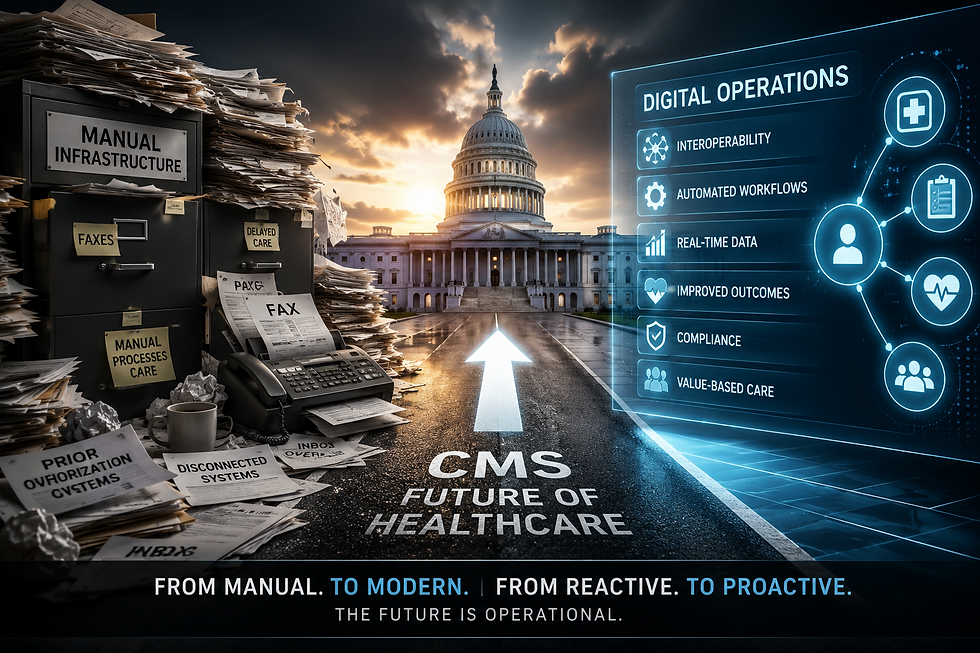
When an EHR vendor can shape who gets access to electronic health information, how quickly, at what cost, and with what practical burden, interoperability stops being “IT.” It becomes a patient safety control, a workforce capacity constraint, and a determinant of value based care performance.
This problem is most visible at transitions, where errors and delays compound quickly: hospital to skilled nursing facility, hospital to home health, SNF to emergency department, and coordination across senior living where residents receive care from multiple external providers.
What the Texas case signals, in operating terms
Texas alleges that Epic is the dominant provider of electronic health records in the United States and uses an “anticompetitive playbook” that harms competitors and prevents hospitals and patients from accessing key data.[4] Paxton’s office frames the case as both market conduct and parental proxy access, including allegations that vendors can restrict parents’ access to minors’ records through portal default settings.[1][2]
Epic rejects the lawsuit as “flawed and misguided,” and argues that clients decide parental access, not Epic.[2][3] Epic also cites large scale record exchange, stating it handles more than 725 million record exchanges monthly, with more than half involving non Epic systems.[2][3]
The litigation also lands in a context of ongoing scrutiny. Particle Health sued Epic under federal antitrust law, and a federal judge allowed key portions of Particle’s monopolization claims to proceed.[5] The details will play out in court, but the pattern matters: multiple parties are alleging that data access and integration dynamics can be used as competitive levers.

EHR Interoperability is not a feature. It is a safety control.
Many organizations still treat interoperability as a “nice to have,” mainly associated with patient portals or innovation programs. That framing is outdated.
Interoperability is a safety control because it determines whether clinicians and care teams have timely, usable, and complete context when decis
ions are made. A discharge summary that arrives late is not just inconvenient. It is a risk amplifier.
Nowhere is this clearer than hospital to SNF transitions. These transitions are high acuity, high medication burden, and operationally compressed. Evidence shows how fragile the information flow remains.
Medication discrepancies occur in almost three out of four SNF admissions and involve about one in five medications prescribed on admission.[11]
In a national survey of hospital to SNF pairs, only 13.5 percent reported excellent performance across completeness, timeliness, and usability of information sharing. Information sometimes, often, or always arrived after the patient. Social status and behavioral status were frequently missing.[10]
If you lead a health system that is serious about reducing readmissions, or a post acute platform that is serious about preventing avoidable escalation, those numbers should be treated like a clinical risk register entry, not like an integration annoyance.
Policy makers already recognize that data friction can harm care. The Office of the National Coordinator for Health IT describes information blocking as a practice likely to interfere with access, exchange, or use of electronic health information.[6] The federal information blocking framework is codified in regulation, including defined exceptions.[7]
Why EHR integration still feels hard in 2025
Standards have improved. Yet most operator experiences still look like this: “integration is possible,” but “integration is hard.” The persistent gap is driven by incentives and governance as much as by technology.
Switching costs protect incumbents. If exporting full fidelity data is expensive, if rebuilding workflows is slow, and if best of breed tools cannot run alongside the core EHR without friction, then the EHR becomes both system of record and system of control. Texas alleges behavior consistent with that dynamic, including interference with hospitals’ ability to use their own data and friction that deters competitors.[1][2][4]
App onboarding can become a gated marketplace. Even when APIs exist, real world deployment can be slowed by contract terms, fees, review processes, and operational constraints that are difficult to predict. For executives, “has an API” is not the question. “Can we deploy a new clinical or operational tool on a predictable timeline with predictable costs” is the question.
Security review can become a blunt instrument. HIPAA grade controls matter, and legitimate risks exist. But when security review becomes inconsistent or protracted, it creates the same outcome as a competitive choke point. The right answer is not weaker security. It is clearer, auditable requirements and in boundary designs that reduce risk while keeping deployment practical.
Post acute and senior living get deprioritized. Hospitals dominate roadmaps, yet downstream settings absorb complexity and drive utilization. When these settings are treated as an afterthought, information arrives late, missing, or unusable, and staff fill the gap manually.[10]
The cost of data friction shows up as utilization and labor
Executives should evaluate interoperability across two measurable dimensions: avoidable utilization and avoidable labor.
Avoidable utilization and value based care performance
Timely data access reduces redundant testing and improves clinical decision making. Health information exchange has empirical support for reducing repeat imaging in emergency departments.[12][13] More importantly, the same mechanism applies to transitions: complete, timely discharge information reduces medication harm, avoids duplication, and reduces preventable returns to acute care.
Avoidable labor and burnout
Every missing data element becomes a human workflow: fax chases, portal logins, phone calls, re documentation, and repeated assessment. When information arrives after the patient, teams are forced into reactive care planning.[10] That is not scalable, and it is a direct contributor to burnout across nursing, care management, and medical directors.
In senior living, residents often receive care from multiple sites and specialists. If the community lacks reliable ways to receive clinical context, staff end up calling families and offices to reconstruct the story, and the work compounds during evenings and weekends.
“Ownership” is not enough. Portability is what matters.
The Texas complaint and press release emphasize that patient and hospital data is not the vendor’s property.[1][4] That framing resonates, but leaders should treat “ownership” as incomplete.
Portability requires operational capabilities: clinically usable exports, identity and consent workflows, role based access controls and audit trails, timeliness, and clear accountability when exchange fails. This is why nationwide frameworks exist.
TEFCA is intended to support nationwide exchange by connecting health information networks under a common governance and legal framework.[8] CMS has also advanced payer interoperability and patient access through its Interoperability and Patient Access Final Rule, focused on patient access and data exchange for Medicare Advantage, Medicaid, CHIP, and certain marketplace plans.[9]
What C suite and clinical leaders should do now
You do not need to wait for litigation outcomes to reduce risk.
Start by naming the problem in business terms. Data friction is a hidden tax on throughput. It increases average length of stay because placements and handoffs take longer. It increases avoidable ED transfers because downstream teams are flying partially blind. It increases labor cost because highly trained clinicians spend time doing clerical reconstruction. When leaders frame interoperability as cost avoidance and risk reduction, priorities get clearer.
First, treat interoperability like a quality domain with KPIs. Track completeness, timeliness, and usability of transition data, especially hospital to SNF and SNF to ED. The JAMA Network Open measures offer a practical blueprint.[10]
Second, move data mobility into core contract terms. Require defined export formats, defined API performance, clear fee schedules, and defined onboarding timelines for third party tools. Make sure these clauses apply to post acute partners, not only to hospital modules.
Third, operationalize FHIR in production, not in slideware. Validate the use cases that drive outcomes: discharge packets to SNFs, medication reconciliation inputs, labs and imaging results, problem lists, and clinical notes where appropriate. If your vendor points to “record exchange volume,” ask whether that exchange delivers the specific fields your teams need at the moment decisions are made.[2][3][10]
Fourth, design for in boundary PHI handling. If you deploy automation or AI, insist on minimum necessary access, auditability, and local de identification where appropriate. This reduces legitimate security objections and shortens review cycles without weakening compliance.
Three questions that are worth asking your CIO and compliance leadership this quarter:
• For hospital to SNF transitions, what percentage of discharges deliver a complete medication list and usable clinical summary to the receiving team before the patient arrives?
• What is our average time and all in cost to onboard a third party clinical tool that needs EHR data, from request to production?
• If we had to switch vendors, can we export full fidelity data and workflows in a clinically usable format on a defined timeline, or is it effectively undefined?
Why this matters most in SNFs and senior living
SNFs operate at the intersection of high acuity care and constrained staffing. Senior living communities operate at the intersection of resident experience and clinical fragmentation. Both depend on timely data and clear accountability.
Medication discrepancies and incomplete transition information remain common.[10][11] That reality increases risk for patients, increases preventable hospital use, and increases staff workload. It also undermines payer and provider strategies to manage populations safely outside the hospital.
Conclusion: the new standard is data liquidity
The Paxton lawsuit is a headline, but the underlying issue is a long standing operational tax.[1][4] In the next era of healthcare, the winners will be organizations that can move clinical and operational data safely, quickly, and predictably across settings.
That capability enables fewer adverse events at transitions, fewer avoidable hospital visits, lower staff burden, and faster adoption of high value innovation. It also strengthens relationships across the continuum, including post acute partners and senior living communities that influence outcomes.
Executives should treat interoperability as core infrastructure, governed like a safety domain, procured like a strategic asset, and measured like a financial lever.
SOURCES
[1] Texas Attorney General press release (Dec 11, 2025)
[2] Healthcare Dive coverage (Dec 12, 2025)
[3] Healthcare IT News coverage (Dec 12, 2025)
[4] Bloomberg coverage (Dec 11, 2025)
[5] Reuters on Particle Health case (Sep 8, 2025)
[6] ONC Information Blocking overview
[7] 45 CFR Part 171 (Information Blocking regulation)
[8] ONC TEFCA overview
[9] CMS Interoperability and Patient Access Final Rule (CMS 9115 F)
[10] JAMA Network Open: Hospital to SNF information sharing (2021)
[11] Medication discrepancies in hospital to SNF admissions (Tjia et al., 2009, full text)
[12] HIE associated with reduced repeat ED imaging (Lammers et al., 2014, PubMed)
[13] HIE and repeated imaging for back pain (Bailey et al., 2013, PubMed)


Comments