
The CY 2027 MA Rule: How CMS's Refocus on Outcomes Creates an Imperative for Clinical AI Orchestration
- Ernie Ianace, CEO

- Dec 1, 2025
- 6 min read
Executive Summary: The End of Administrative Easy Wins
The Centers for Medicare & Medicaid Services (CMS) Contract Year (CY) 2027 Proposed Rule marks a critical inflection point for Medicare Advantage (MA) Organizations. By proposing to remove 12 administrative and process-focused measures from the Star Ratings system and adding a new clinical measure (Depression Screening and Follow-Up), CMS is sending a clear, unequivocal message: The era of earning Star Ratings and Quality Bonus Payments (QBPs) through simple administrative compliance is over.
This move creates a profound operational imperative. Plans can no longer rely on processes that have already achieved high, non-distinguishable performance. Instead, they must now concentrate resources on achieving measurable health outcomes, deep clinical integration, and improved patient experience—areas where performance truly varies.
For MA organizations, senior living operators, and Value-Based Care (VBC) entities, this regulatory shift is a direct mandate to adopt high-reliability clinical orchestration. CareAlly is the essential operational layer designed to meet this demand, providing the automated, interdisciplinary workflows necessary to capture the complex, patient-centric data now required to succeed in CY 2027 and beyond.

Section 1: The Great Star Ratings Purge—Shifting Focus from Process to Precision
CMS is proposing to streamline and refocus the Part C and Part D measure set by removing 12 measures, primarily those focused on administrative processes or areas where performance variation is minimal (the ceiling effect). This "purge" is not merely trimming fat; it is redefining the basis for competitive advantage.
CMS Action | Strategic Interpretation for MA/VBC Leaders |
Removal of 12 Administrative Measures | Administrative Cost/Burden Reduction: CMS acknowledges the resource drain associated with measures that do not differentiate quality. The freed resources must now be deployed where they generate measurable clinical value. |
Focus on Clinical Variation | The Clinical Mandate: The remaining and new measures focus intensely on clinical care, patient outcomes, and patient experience. Success requires verifiable, coordinated, and personalized care delivery, not just accurate documentation of compliance. |
This signals that achieving a 4- or 5-Star rating now requires platforms that influence care delivery at the bedside and across the continuum, rather than just tools for regulatory reporting. The challenge shifts irrevocably from compliance documentation to outcomes generation. This is a direct architectural prompt: the MA ecosystem requires a high-reliability clinical operations layer.
Section 2: The New Clinical Imperative—Behavioral Health, SDOH, and Integrated Care
The Proposed Rule introduces a new Part C Depression Screening and Follow-Up measure and includes Requests for Information (RFIs) on incorporating well-being and nutrition (Social Determinants of Health/SDOH) into future policy. These additions reveal CMS's commitment to holistic, complex care management, forcing MAOs to solve the persistent problem of fragmented clinical data.
Addressing Behavioral Health Complexity
The Depression Screening and Follow-Up measure is a significant clinical challenge because:
Workflow Fragmentation: It demands standardized screening, accurate risk stratification, and meticulous interdisciplinary follow-up (PCP, specialist, social services)—a workflow prone to manual handoffs and failure.
VBC Impact: Undiagnosed or untreated depression is a major driver of poor chronic disease outcomes, readmissions, and higher overall costs—precisely the metrics that erode VBC profitability.
CareAlly’s Orchestration for New Measures
CareAlly is engineered to meet this new standard by providing the automated workflows necessary to close these clinical loops:
Automated Screening Triggers: CareAlly integrates with EHRs and resident engagement inputs (AgeWellAlly) to trigger standardized screening workflows based on risk stratification or scheduling events.
Interdisciplinary Routing: If a depression screening is positive, the system instantly routes follow-up tasks—such as scheduling with a behavioral health specialist or initiating care team discussion—based on persona, acuity, and regulatory standards. This eliminates the staff time wasted in manual handoffs and ensures faster care-plan generation for behavioral health concerns.
Data Aggregation: The platform centralizes follow-up adherence, providing an auditable record of the entire process, directly supporting the measure's documentation requirements.
Responding to the SDOH Mandate
The RFI on well-being and nutrition signals that future payment models will incorporate SDOH data. CareAlly’s core function—synthesizing data across the entire ecosystem—is already positioned to capture, document, and route tasks related to SDOH. This ensures that essential non-clinical information (e.g., food insecurity, social isolation alerts from AgeWellAlly) is automatically incorporated into the CareAlly clinical workflow, providing an integrated view essential for future quality metrics and holistic risk adjustment.
Section 3: The VBC Financial Tightrope—Responding to Risk Adjustment Modernization
CMS is seeking feedback on enhancing competition and modernizing the risk adjustment system, recognizing that the current model may incentivize over-coding ("coding more intensely than Original Medicare") and disadvantages smaller, innovative plans. This creates a dual financial and architectural challenge:
RFI 1: Next-Generation Risk Adjustment and AI Transparency
The RFI explicitly explores leveraging artificial intelligence and alternative data sources for risk adjustment. This poses two critical imperatives:
Auditing Risk Intensifies: CMS is looking for ways to scrutinize coding more intensely. This creates an urgent need for MA organizations to ensure their documentation is not only complete but verifiably accurate and supported by robust clinical evidence. The risk of future claw-backs due to insufficient documentation is rising.
Demand for AI-Driven Transparency: The proposal to leverage AI for risk adjustment demands that provider systems, like CareAlly, can generate transparent, auditable clinical summaries. The underlying AI must be a "glass box"—not a "black box"—capable of producing a definitive, auditable providence trail (provided by the InsightAlly fabric). This is a mandate for Explainable AI (XAI) in revenue cycle management.
The solution is not more administrative coders; it is clinical orchestration that ensures complete, accurate documentation occurs as a byproduct of care delivery. CareAlly's automated intake sniffers and clinical summarization tools ensure all relevant codes are supported by rich narrative and captured at the point of care, mitigating coding risk and maximizing QBP potential.
RFI 2: C-SNP/D-SNP Integrity and Integrated Care
CMS is also addressing the growth in Chronic Special Needs Plans (C-SNPs) enrollment, particularly concerns about dually eligible individuals enrolling in C-SNPs rather than Dual Eligible Special Needs Plans (D-SNPs), which offer integrated Medicare-Medicaid benefits.
This signals a regulatory push for true clinical integration for vulnerable populations. Simply holding both contracts is insufficient; MAOs must demonstrate coordinated, single-source care management across the two programs. CareAlly's interdisciplinary workflow model is architecturally designed to handle this complexity by routing work based on the beneficiary’s dual status and associated protocols, ensuring seamless coordination that aligns with the integration intent of D-SNPs.
Section 4: Quantifying the Imperative—CareAlly’s Measurable Orchestration Value
The CMS CY 2027 Proposed Rule is a clear validation of the CareAlly model. The regulatory environment demands intelligent orchestration that connects data, staff, and clinical protocols to generate measurable value.
The core competitive advantage is no longer a unique benefit design but the operational efficiency and clinical fidelityof the care delivery platform. CareAlly provides the high-reliability clinical operations layer required to manage acuity, staffing, and compliance simultaneously.
Illustrative Scenario: VBC Claims Financial Risk Mitigation
For complex, risk-bearing claims like Institutional Special Needs Plans (ISNPs) and Chronic Special Needs Plans (CSNPs), the administrative burden of required documentation is immense and prone to error, leading to financial leakage.
Anticipated Outcome: Implementing the CareAlly workflow for claims submission, leveraging the InsightAlly Fabric’s auditable data synthesis, is projected to result in the net saving of three full-time employees (FTEs)who would otherwise be dedicated to managing the complex documentation and appeal processes for these high-stakes claims. This provides a verifiable and recurring reduction in administrative overhead, redirecting staff time to higher-value clinical activities.
Illustrative Scenario: CCRC Clinical Velocity and Staff Empowerment
The shift away from process measures demands that MAOs focus on reducing friction in core clinical processes like intake and care planning, which directly impacts staff time saved and speed to competency.
Anticipated Outcome: For a large Continuing Care Retirement Community (CCRC), automating the CareAlly Admission Connect workflow is expected to achieve a time saving of 30 to 45 minutes per admission by synthesizing pre-admission data. Furthermore, the automated generation of the initial care plan is projected to save an additional 30 minutes per case, accelerating compliance and freeing up clinical staff to focus on direct resident engagement. This measured reduction in cognitive load is a key factor in staff retention and superior clinical fidelity.
CMS Mandate (CY 2027) | CareAlly’s Measurable Solution | Operational Value |
New Depression Screening Measure | Interdisciplinary Workflow Automation: Automatic task routing and adherence monitoring for follow-up. | Faster Care-Plan Generation and Staff Time Saved in clinical coordination. |
VBC Risk Adjustment Scrutiny | Automated Intake Sniffers & Summarization: Ensures complete, auditable clinical documentation beforesubmission. | Financial Performance maximized by accurate risk coding and reduced denial risk. |
Focus on Clinical Outcomes | Decision Support & Acuity Routing: Real-time guidance and resource allocation based on patient risk/needs. | Avoided Hospital Transfers by driving proactive, high-reliability care interventions. |
RFI on Well-being/Nutrition (SDOH) | AgeWellAlly Input Integration: Captures structured inputs from the engagement layer (family/resident). | Enhanced Data Capture for future quality measures, improving holistic VBC scores. |
Conclusion: The Imperative for Integrated AI
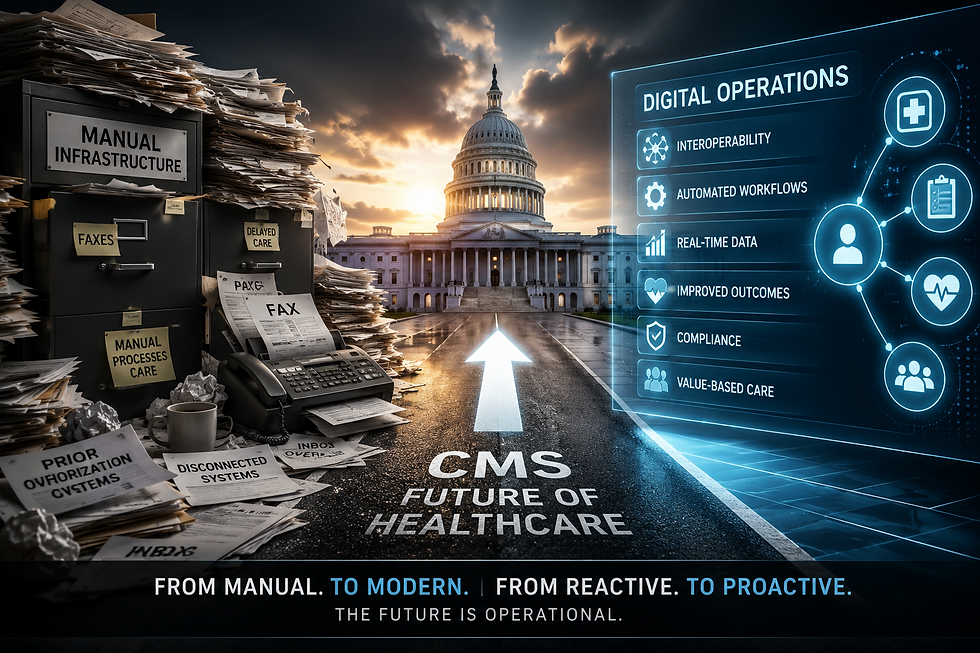
The CY 2027 MA Proposed Rule is an urgent call for modernization. The shift from rewarding administrative process to demanding verifiable clinical outcomes means MA organizations must pivot their technology investment from siloed reporting tools to integrated, intelligent orchestration platforms.
CareAlly is not a passive data aggregation tool; it is an active, high-reliability operational system that drives work based on acuity, persona, and regulatory standards. It transforms the complexity of CMS mandates into streamlined, measurable clinical execution.
For clinical leaders, it offers a direct path to reducing burnout and increasing speed to competency by automating administrative burden. For C-suite leaders, it is the strategic infrastructure required to protect and grow financial performance under the increasingly strict metrics of VBC and Star Ratings. The new MA landscape demands a decisive move to clinical orchestration to ensure not only compliance but sustained operational excellence and superior health outcomes.


Comments