
Medicare Advantage Operations 2026: The MA Squeeze and the SNP Surge

Medicare Advantage operations 2026 will look fundamentally different from the prior decade.
Enrollment growth has slowed to roughly 3 percent, reaching approximately 35.5 million beneficiaries. At the same time, more than 80 percent of that net growth is concentrated in Special Needs Plans, particularly Dual Eligible SNPs and Chronic Condition SNPs. Broad-based MA expansion has plateaued. Complexity has not.
CMS is simultaneously tightening payment accuracy rules and refining risk adjustment mechanics in the CY 2027 Advance Notice. The projected net payment update is near flat, and CMS has proposed excluding diagnoses captured outside of linked clinical encounters from risk scores beginning in 2027. That single policy direction reshapes the revenue mechanics many plans relied on for years.
The result is clear. Medicare Advantage operations in 2026 are no longer about scale. They are about precision.

Why Medicare Advantage Operations 2026 Require a Structural Reset
For most of the past decade, MA competitiveness centered on benefit design, network configuration and geographic expansion. That model worked in a rising enrollment and stable risk adjustment environment.
That environment no longer exists.
Flat payment updates combined with elevated utilization mean margin now lives or dies inside operational execution. At the same time, CMS scrutiny around documentation integrity and encounter linkage increases the cost of imprecision.
Retrospective chart review strategies that once buoyed risk scores face material compression if unlinked diagnoses are excluded. Revenue now depends on evidence captured in real clinical workflows, tied directly to encounters and auditable documentation.
Medicare Advantage operations 2026, therefore, shift from revenue enhancement to revenue integrity.
The SNP Surge Is Not a Product Trend. It Is an Operational Challenge.
Special Needs Plans are driving the majority of MA enrollment growth. That matters because SNPs are operationally distinct.
Dual status changes. Medicaid eligibility volatility. Higher social determinant burden. Frequent transitions across care settings. Increased care coordination requirements. More intensive documentation demands.
Traditional MA operating models were built for scale across relatively stable populations. SNP growth requires orchestration across dynamic, high acuity members whose eligibility and care environments shift frequently.
In Medicare Advantage operations 2026, the center of gravity moves toward these populations. Organizations that cannot execute at SNP level complexity will struggle to maintain margin even if enrollment rises.
Payment Accuracy Is Becoming Operational Strategy
CMS messaging is consistent. Payment accuracy and sustainability are priorities. The Advance Notice language reinforces a shift away from loosely supported diagnoses and toward encounter-linked validation.
Operational implication:
• Documentation must be embedded in clinical workflow, not added retrospectively
• Eligibility and roster reconciliation must be continuous, not periodic
• Care gap closure must be structured and auditable
• Evidence capture must withstand regulatory review
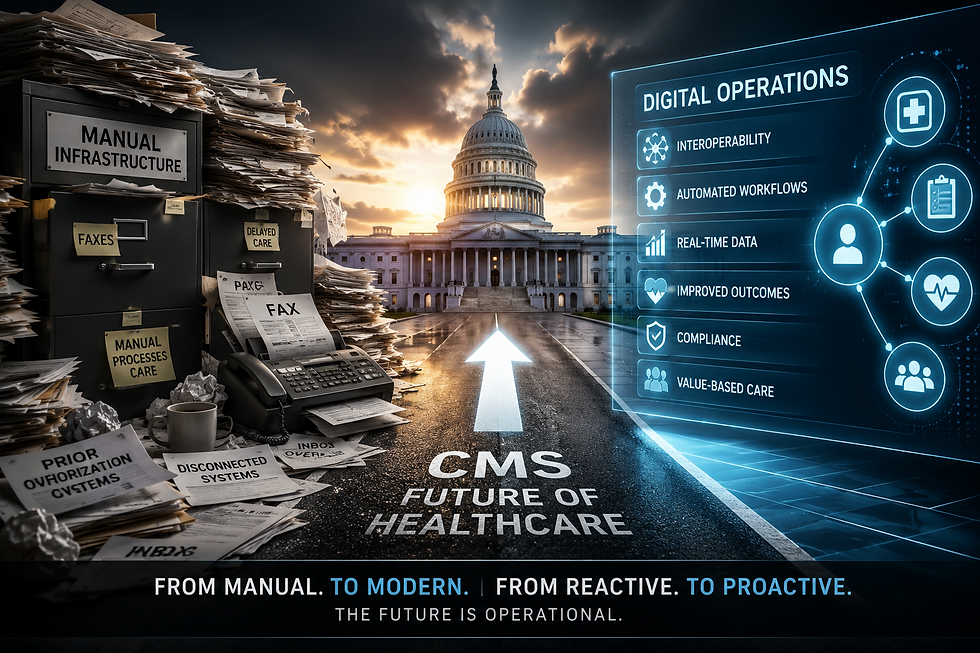
This is not a technology conversation. It is an operating model conversation.
Medicare Advantage operations 2026 demand an infrastructure layer that reduces variance, enforces workflow consistency and creates traceable audit trails.
What High-Performing Medicare Advantage Operations 2026 Look Like
Organizations that adapt quickly will demonstrate measurable outcomes within twelve months:
Reduced avoidable emergency department utilization through tighter transition management in SNP populations
Improved risk score stability through encounter linked documentation and proactive evidence capture
Staff time saved across eligibility monitoring, roster reconciliation, and documentation chase workflows
Higher performance in value-based contracts through consistent care gap execution
Operational consistency becomes the differentiator.
The Required Infrastructure Shift
CareAlly is built specifically for this environment.
CareAlly is a persona-based AI orchestration platform that integrates with EHRs, Slack, Teams, Salesforce, Smartsheet, HubSpot, Office, Google, and Apple. It operates inside HIPAA boundaries and supports local de-identification models.
The platform enables:
Persona-based workflow routing so care managers, coders, clinicians and administrators execute role-appropriate tasks in a coordinated sequence
API first integration across clinical, claims, and enterprise systems to maintain continuous eligibility and documentation integrity
In boundary PHI handling with full auditability to support regulatory scrutiny and payment integrity
In Medicare Advantage operations 2026, the differentiator is not who adds the most staff. It is who installs the most disciplined operational infrastructure.
Conclusion
The MA squeeze and the SNP surge are not temporary market fluctuations. They represent a structural shift.
Medicare Advantage operations 2026 are defined by tighter payment accuracy, slower broad enrollment growth and increasing concentration in high acuity SNP populations.
In this environment, operations become strategy.
Organizations that treat workflow precision, documentation integrity and orchestration as core capabilities will protect margin and improve outcomes.
Those that continue to rely on fragmented processes and retrospective fixes will feel compression accelerate.


Comments