
What the CMS ACCESS Model Is Really Designed to Force in 2027 and Beyond

The CMS ACCESS Model is being described in many circles as a chronic care innovation. That framing is incomplete.
Viewed in isolation, ACCESS looks like a voluntary model designed to improve management of hypertension, diabetes, musculoskeletal conditions, and behavioral health through technology enabled care. Viewed in context of recent rate releases, risk adjustment tightening, and encounter validation pressure, it becomes something more consequential.
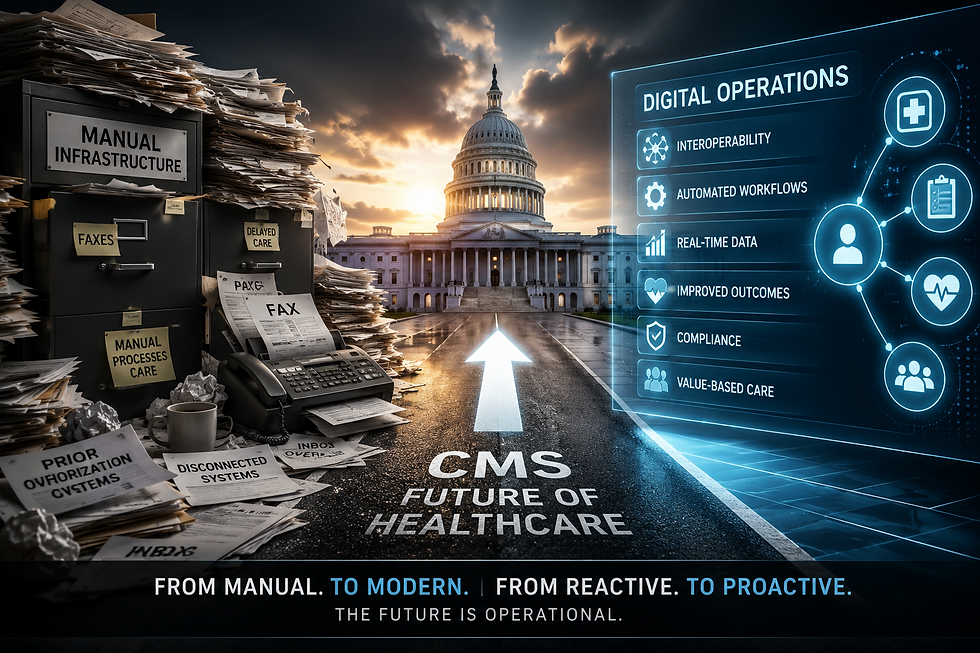
The CMS ACCESS Model is not primarily about expanding reimbursement. It is about forcing operating model maturity in Medicare.
This distinction matters now more than when the model was first announced. Flat payment environments and stricter risk validation rules remove the economic cushion that once allowed inefficiency to persist. ACCESS arrives at precisely the moment CMS is signaling that longitudinal accountability is no longer aspirational. It is assumed.
Understanding what the CMS ACCESS Model is really designed to force will determine whether organizations treat it as an optional pilot or as a preview of the next decade of Medicare design.

The CMS ACCESS Model Is About Longitudinal Infrastructure, Not New Billing
At a surface level, the CMS ACCESS Model introduces outcome aligned recurring payments tied to improvement in specific chronic condition tracks. Participating organizations receive support to deploy technology enabled interventions and are evaluated based on measurable clinical change.
But the structural signal is more important than the clinical tracks themselves.
The CMS ACCESS Model asserts three operating assumptions:
First, chronic disease management must move from episodic intervention to continuous trajectory management.
Second, technology enabled monitoring, engagement, and analytics are assumed infrastructure, not optional enhancements layered onto traditional care.
Third, measurable improvement across time matters more than documenting activities performed within a month.
These assumptions align tightly with the broader direction CMS is reinforcing across Medicare Advantage, risk adjustment validation, and quality measure evolution. ACCESS is not a one off innovation experiment. It is a stress test of whether care delivery organizations can produce durable, measurable improvement without relying on episodic billing logic.
It is important to state clearly that the CMS ACCESS Model does not replace Remote Patient Monitoring or Chronic Care Management. RPM and CCM remain reimbursable services under existing rules. However, ACCESS shifts the economic logic.
RPM and CCM reward activity performed. ACCESS rewards improvement achieved.
That difference, while subtle on paper, represents a structural redesign of incentives.
Why the CMS ACCESS Model Matters More After Recent Rate Releases
Recent CMS rate updates have cooled payment growth and increased scrutiny on coding integrity. Risk normalization pressures, validation of encounter linked diagnoses, and tightening of retrospective capture have changed the financial environment.
In higher growth periods, organizations could often offset operational inefficiencies with incremental revenue expansion. In flatter environments, inefficiency becomes visible.
The CMS ACCESS Model operates within this new reality.
It assumes organizations can:
• Continuously track risk and clinical progression
• Integrate clinical, behavioral, and social inputs into a shared view
• Surface deterioration before acute escalation
• Demonstrate measurable improvement across a defined population
This requires infrastructure. Not staffing heroics. Not retrospective reconciliation. Infrastructure.
Under ACCESS, improvement cannot be inferred from billing patterns. It must be demonstrated through measurable clinical change over time. That shifts the center of gravity from documentation to orchestration.
For executive teams, the implication is straightforward. ACCESS is not a reimbursement lever. It is a readiness evaluation.
The CMS ACCESS Model and the End of Episodic Chronic Care
For decades, chronic disease management in Medicare has operated through a series of episodic interventions. A visit occurs. A code is billed. A device is supplied. A month of monitoring is logged.
This structure incentivized service documentation rather than trajectory improvement.
The CMS ACCESS Model challenges that orientation by aligning recurring payments with sustained improvement in chronic condition metrics. That means:
• Blood pressure trends matter more than a single visit
• Glycemic control across months matters more than one check in
• Functional improvement in musculoskeletal conditions matters more than documented education sessions
The operational implication is that care teams must think in trajectories rather than transactions.
This aligns with what value based care contracts have demanded for years. The difference is that ACCESS brings this logic directly into the structure of Original Medicare.
Organizations that have already invested in longitudinal care orchestration will recognize this as validation. Organizations that remain organized around episodic documentation will experience ACCESS as pressure.
Technology as Assumed Infrastructure Under the CMS ACCESS Model
Another misinterpretation of the CMS ACCESS Model is that it exists to expand digital health reimbursement. While technology enabled care is central to the model, the intent is not to subsidize devices or platforms.
The intent is to normalize technology enabled chronic care as a baseline capability.
In the ACCESS framework, connected devices, asynchronous engagement, analytics, and care coordination tools are not novel features. They are expected components of delivering measurable improvement at scale.
This reframes technology from optional enhancement to structural requirement.
For senior living operators, ACOs, and Medicare aligned providers, this means:
• Remote monitoring must integrate directly into clinical decision making
• Data from devices must flow into care planning, not sit in dashboards
• Engagement workflows must trigger escalation pathways, not simply reminders
• Analytics must identify risk early enough to change trajectory
Without these capabilities, measurable improvement across defined cohorts becomes difficult to demonstrate.
The CMS ACCESS Model does not explicitly mandate a specific technology stack. But its payment logic assumes that organizations can operationalize technology in ways that produce sustained clinical change.
That assumption is the signal.
How the CMS ACCESS Model Intersects With Medicare Advantage and SNP Strategy
While ACCESS sits within Original Medicare, its structural assumptions mirror pressures unfolding in Medicare Advantage and Special Needs Plans.
Flat rate growth, encounter based validation, and outcome weighted quality measures are converging on the same theme: documentation alone is insufficient. Performance must be observable.
For organizations serving high acuity populations, including D SNPs, C SNPs, and I SNPs, the CMS ACCESS Model functions as a preview of broader expectations.
Consider what ACCESS requires:
• Defined chronic cohorts
• Continuous measurement of improvement
• Demonstrable trajectory change
• Cross disciplinary coordination
These are the same capabilities required to perform under tightened risk adjustment and evolving quality metrics in Medicare Advantage.
In that sense, ACCESS is less a niche model and more a structural alignment signal. It harmonizes Original Medicare with the longitudinal accountability logic that has been building in managed care.
For executives planning five year strategies, the message is clear. Investment decisions should not be driven solely by whether an organization participates in ACCESS. They should be driven by whether the organization can meet the operational assumptions ACCESS encodes.
What the CMS ACCESS Model Is Forcing Leaders to Confront
The most consequential question raised by the CMS ACCESS Model is not whether an organization can enroll participants. It is whether its operating model can produce measurable improvement without relying on episodic billing.
This forces several uncomfortable assessments.
First, is chronic care management still largely reactive rather than proactive?
Second, do care teams share a unified view of patient trajectory, or is information fragmented across systems?
Third, are technology investments integrated into decision making, or are they layered alongside traditional workflows?
Fourth, can the organization demonstrate sustained improvement across a population, not just activity within a reporting window?
These questions extend beyond ACCESS. They speak to readiness for the next phase of Medicare design.
CMS is behaving as though longitudinal infrastructure already exists. In many organizations, it does not. Where it does exist, it is often fragile and person dependent.
The CMS ACCESS Model will expose that fragility.
Strategic Actions for C Suite and Clinical Leaders
Leaders evaluating the CMS ACCESS Model should resist the temptation to treat it as a narrow innovation opportunity. Instead, it should be used as a diagnostic lens.
Practical steps include:
Map chronic care workflows end to end. Identify where trajectory management breaks down.
Align technology investments with measurable outcome objectives rather than reimbursement opportunities.
Ensure device data, clinical documentation, and engagement signals flow into a unified care view.
Develop internal metrics that track sustained improvement across defined cohorts.
Evaluate whether current staffing models support proactive outreach or remain organized around reactive visits.
These actions are relevant regardless of formal ACCESS participation. The model simply accelerates the need to confront them.
Conclusion: The CMS ACCESS Model as Structural Inflection Point
The CMS ACCESS Model is not primarily about expanding payment for chronic care services. It is about redefining how Medicare evaluates chronic care performance.
By aligning recurring payments with measurable improvement and embedding technology enabled care into its assumptions, ACCESS shifts the economic center of gravity from activity to outcome.
In a flatter rate environment with increasing scrutiny on coding integrity and encounter validation, this shift becomes even more significant. Organizations can no longer rely on documentation strategies to compensate for fragmented care design.
They must produce sustained improvement.
The CMS ACCESS Model is not a replacement for RPM or CCM. It is a signal that episodic billing logic is insufficient for the next decade of Medicare policy.
For executive and clinical leaders, the choice is not whether to monitor ACCESS as a pilot. It is whether to treat it as a blueprint.
In the coming years, readiness will not be defined by compliance. It will be defined by measurable, durable improvement in chronic disease trajectories.
ACCESS is how CMS is testing that readiness now.


Comments