
The Modular Era of Healthcare AI Has Arrived. Here Is What It Means for Leaders Who Need Real Outcomes, Not More Tools
- Ernie Ianace, CEO

- Nov 21, 2025
- 6 min read
Most AI pilots in healthcare fail for the same reason: they add work instead of removing it. Healthcare and senior living leaders face a critical moment. The market is flooded with AI pilots that promise transformation but end up delivering more dashboards, alerts, and administrative tasks for teams already under intense pressure. Most solutions automate individual tasks, but few actually improve workflow. Even fewer lessen the cognitive burden on clinical staff. This gap between potential and reality explains why frontline teams are skeptical and executives are cautious.
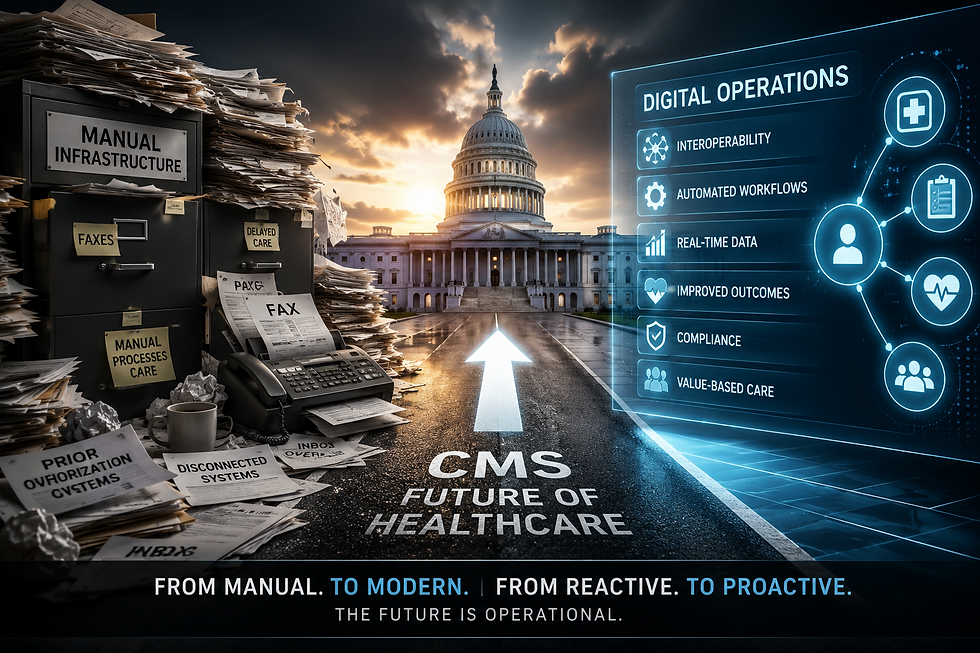
A new architectural model is emerging that finally resolves this tension. McKinsey’s recent analysis on modular healthcare AI clearly captures this shift. Isolated features or narrow tools will not characterize the next era of AI. Instead, it will be defined by modular, orchestrated intelligence that pulls data from the systems organizations already depend on, understands each person's role in the workflow, and produces structured, defensible outputs without adding burden. This marks the difference between automation and orchestration.
Organizations that adopt this architectural model early will gain measurable advantages. Faster clinical decisions. Fewer preventable hospital visits. Staff time returned to direct care. Greater consistency across facilities. Better performance in value-based care programs. A more predictable and safer resident and patient experience.
CareAlly was built from the ground up for this moment. What follows is a definitive view of why the modular era is here, why it matters, and how orchestration becomes the operational backbone that C-suite and clinical leaders have been waiting for.
A Provocative Insight: AI Does Not Fail Because of Accuracy. It Fails Because the Workflow Is Wrong.
The industry spends too much time debating model accuracy and not enough time confronting the real reason AI fails inside healthcare organizations. AI does not fail because the models are weak. It fails because the workflows are fragmented. When clinical teams are forced to jump between systems, reconcile inconsistent data, interpret unstructured notes, and manually route information, even the best AI models cannot create value. The limiting factor is not intelligence. It is workflow design.
Executives often look at failed pilots and assume the technology was not ready. In reality, the workflow was not ready for the technology. Without orchestration, AI becomes another surface area for alerts, inconsistencies, and manual oversight. This is the uncomfortable truth. AI that is not embedded in the clinical and operational workflow will always add burden rather than remove it. Organizations that fix their workflows can adopt AI faster, more safely, and with far greater ROI.
Fragmentation Remains the Most Expensive Problem in Healthcare
Every executive knows that fragmentation is the silent tax on care delivery. It shows up in duplicated work, delayed escalations, incomplete handoffs, inaccurate documentation, inconsistent communication with families, inefficient interdisciplinary coordination, and rising burnout.
The root cause is simple. Clinical workflows span systems, disciplines, roles, and locations. Most technology solutions do not.
A change in condition touches vitals, progress notes, medication records, responsible parties, scheduling, and the plan of care. A hospital transfer requires rapid access to recent vitals, notes, medications, allergies, advance directives, and family contacts. A medication change impacts risk scoring, care planning, pharmacy coordination, and family communication.
These are orchestrated workflows. They cannot be solved by tools built to automate one task at a time.
The market is recognizing this. Leaders are no longer asking whether AI can help. They are asking how AI can reduce work while improving outcomes. Modular architecture is the answer.

The Executive ROI: Where Orchestration Produces Financial and Operational Lift
C-suite leaders evaluate technology through one lens: measurable impact on cost, revenue, risk, and workforce stability. Orchestration delivers ROI in ways single-task tools cannot.
Reduced preventable hospital visits.
Avoidable transfers carry direct costs for operators, disrupt staffing, strain families, and weaken performance in value-based care contracts.
Higher documentation completeness and accuracy.
Structured outputs improve billing compliance, reduce denials, and strengthen audit defensibility.
Lower labor cost per resident or patient.
Orchestration removes the overhead between tasks and reduces administrative burden, stabilizing schedules and reducing burnout-driven turnover.
Faster onboarding and competency.
New clinical staff ramp faster when the system generates distilled, role-specific context.
Higher throughput in claims and authorization workflows.
As seen in the ClaimsAlly example, orchestrated rule application dramatically improves clean claim rates and reduces write-offs.
Fewer compliance and survey exposure points.
Standardized workflows reduce variability and risk. ROI is measured in hours saved for staff, hospital visits avoided, documentation quality improved, cash flow accelerated, and VBC scoring strengthened.
Why Modular Architecture Fits the Realities of Clinical Workflows
Modular AI does not replace core systems. It connects them. It aligns intelligence with workflows rather than asking teams to change their behavior. It uses persona-based orchestration, so every role receives exactly what is relevant.
Three principles define modular architecture.
Persona-based design.
Nurses, therapists, directors, administrators, and VBC teams require a different context. Orchestration delivers role-specific intelligence.
In boundary intelligence.
Modern platforms apply AI within HIPAA boundaries using local de-identification models, building trust and accelerating adoption.
API first integration.
Healthcare and senior living operate on many systems. Orchestration allows insight to flow across them without operational disruption.
These principles align with real clinical operations and are becoming the enterprise standard.
A Real Workflow Example: Change in Condition
A senior living community or post-acute provider sees hundreds of changes in condition events each month.
Today, a typical workflow looks like this:
A staff member notices a decline. They open the EHR, review notes, check vitals, scan medications, track down the responsible party, message the nurse, wait for a callback, prepare a handoff, and document the event. Documentation varies by staff member. Routing varies by shift. Delays are common. Preventable hospital visits rise because early signals get buried.
Under a modular orchestration model:
The platform detects early patterns. It generates a structured summary for the nurse. It routes the signal to the right person. It prepares documentation. It builds the handoff packet. It updates the EHR. It notifies responsible parties with the correct details.
The nurse does not sift through data. The administrator does not hunt for context. The interdisciplinary team does not guess. The family is not left uninformed. Risk decreases.
This is the difference between AI as a tool and AI as an orchestrated workflow layer.
A Second Workflow Example: ClaimsAlly and Large-Scale Denial Resolution
Many SNP and C SNP operators face a different but equally costly form of fragmentation. Thousands of claims are denied each week for preventable reasons. Staff must check eligibility, interpret coding, verify documentation, evaluate prior authorization rules, and resubmit. The variability is extreme, and delays are constant.
A typical week may involve thousands of denials, each requiring six to ten minutes of review.
With modular orchestration:
ClaimsAlly applies plan rules, evaluates qualification criteria, checks documentation gaps, generates a structured decision output, and prepares the resubmission packet. Staff now validate exceptions instead of manually reviewing every claim.
Financial impact: higher clean claim rates, faster adjudication, fewer write-offs, lower staffing burden, and consistent RCM performance.
This is orchestration applied to operational work at scale.
Workforce Pressure Is Forcing Acceleration
Executives and clinical leaders are confronting a workforce crisis. Staffing ratios are thin. Recruiting slows. Overtime grows. Documentation requirements rise faster than staffing capacity.
AI that adds work will fail. AI that removes friction will scale.
Orchestration reduces chart review, structures documentation, clarifies responsibilities, supports new staff with immediate context, and standardizes workflows across locations.
Examples include:
• Resident status summaries that eliminate manual review
• Automated hospital transfer packets
• Medication summaries for interdisciplinary rounds
• Structured updates feeding back into the record
• Real-time routing of condition changes
• Standardized documentation for reimbursement and VBC scoring
Clinicians trust AI that gives them time back.
Why This Matters Even More in Senior Living and Post-Acute Care
Senior living and post-acute environments operate with unpredictable acuity, decentralized teams, and families expecting transparency. Modular architecture creates a shared operational fabric across care staff, administrators, residents, families, and external partners.
It unifies information scattered across systems. It strengthens interdisciplinary coordination. It reduces shift variability. It improves safety and visibility.
Consistency is not a technology problem. It is an orchestration problem.
The Next 12 Months Will Reshape How AI Operates
Several trends will accelerate enterprise adoption:
EHR ecosystems will open further.
o Interoperability will be expected, not optional.
Agent-based models will become practical.
o AI agents will coordinate tasks across workflows.
Documentation demands will increase.
o Survey and reimbursement pressure will intensify.
Staffing shortages will grow.
o Solutions that add work will fail immediately.
Executives will evaluate AI as infrastructure.
o Architecture will matter more than features.
Consumer expectations will rise.
o Families will expect faster, clearer updates.
AI is becoming operational, not experimental. Winners will unify data, workflow, and intelligence.
A More Urgent Close: The Cost of Waiting Is Rising
Leaders who wait for clarity will fall behind organizations building orchestration now. The cost of hesitation is not missed innovation. It is missed stability. Burnout. Documentation gaps. Weaker VBC performance.
Preventable hospital visits that could have been avoided.
Documentation will not shrink. Expectations from residents, families, payors, and regulators will rise. Dashboards and point solutions will not solve this. Only a unified orchestration layer can reduce work and improve consistency.
The modular era has begun. The organizations that act now will build a resilient operational foundation for years. Those who wait will see the gap widen.
Orchestration is no longer an experiment. It is the infrastructure modern care delivery requires.


Comments