
CMS 2025 Measures Under Consideration Advance Care Planning: Why ACP Is Becoming Core Healthcare Infrastructure

CMS 2025 Measures Under Consideration Advance Care Planning Is a Signal, Not a Draft
Each year, the Centers for Medicare & Medicaid Services releases its Measures Under Consideration list, a document that many organizations still treat as a technical preview meant primarily for quality teams. That interpretation is increasingly dangerous. This analysis of CMS 2025 Measures Under Consideration Advance Care Planning explains why advance care planning is being positioned as core healthcare infrastructure rather than a niche quality activity. The scale and breadth of ACP’s inclusion across Medicare programs signal a fundamental shift in how CMS expects care to be delivered, coordinated, and measured over time.

That interpretation is increasingly dangerous.
The 2025 MUC list is not just a catalog of potential quality measures. It is a directional document that reveals where CMS intends to standardize expectations across the healthcare system. This year, one signal stands out above all others.
Advance Care Planning is being considered across fifteen CMS programs.
Not as a pilot.
Not as a specialty carve-out.
Not as a hospice-adjacent measure.
As a foundational quality expectation spanning inpatient, outpatient, post-acute, ambulatory, dialysis, rural, and long-term care settings.
For healthcare executives and clinical leaders, this is a moment that requires reframing. CMS is not asking whether ACP is valuable. It is asking whether organizations can operationalize it longitudinally.
What CMS Is Explicitly Proposing in the 2025 MUC List
The 2025 Measures Under Consideration list shows Advance Care Planning (MUC2025-020) being evaluated for inclusion across the following programs:
• Ambulatory Surgical Center Quality Reporting
• End-Stage Renal Disease Quality Incentive Program
• Home Health Quality Reporting
• Hospital Inpatient Quality Reporting
• Hospital Outpatient Quality Reporting
• Hospital Value-Based Purchasing
• Inpatient Psychiatric Facility Quality Reporting
• Inpatient Rehabilitation Facility Quality Reporting
• Long-Term Care Hospital Quality Reporting
• Medicare Promoting Interoperability
• Merit-based Incentive Payment System (MIPS)
• Prospective Payment System-Exempt Cancer Hospital Quality Reporting
• Rural Emergency Hospital Quality Reporting
• Skilled Nursing Facility Quality Reporting
• Skilled Nursing Facility Value-Based Purchasing
That breadth matters more than the measure itself. When CMS evaluates a measure across this many programs, it is signaling that the behavior it represents is no longer context-dependent. It is system-defining.
Why This Is an Infrastructure Move, Not a Quality Tweak
CMS uses the MUC process to do three things:
Normalize expectations across settings
Give organizations time to build capability
Signal where future enforcement will land
Advance Care Planning showing up across fifteen programs tells us CMS believes ACP should be:
• Routine, not exceptional
• Updated, not static
• Accessible, not buried
• Actionable at decision points
This is a move away from episodic documentation and toward longitudinal accountability.
CMS is effectively saying that understanding patient goals, preferences, and values is not an adjunct to care. It is a prerequisite.
The Companion Signals Reinforce the Same Direction
Advance Care Planning is not the only signal in the 2025 MUC list aligned to this shift.
Two additional measures reinforce CMS’s intent.
Dialysis Facility Discussion of Patient Life Goals (MUC2025-011)
This measure targets ESRD populations with high utilization, complex decision-making, and predictable trajectories.
CMS is reinforcing that:
• Life goals should inform care planning
• Conversations should be documented and revisited
• Decisions should reflect patient priorities, not default pathways
This is ACP applied to one of Medicare’s most expensive chronic populations.
Previewed “Well-Being Signs” Measures
CMS has also previewed future measures that move beyond preference documentation and into lived experience.
These measures ask patients questions such as:
• Are you satisfied with how things are going?
• Are you involved in things that matter to you?
• Are you functioning at your best in what matters most?
This is not documentation. This is outcome alignment. CMS is shifting from “did you ask” to “did care actually align.”
The Strategic Shift CMS Is Making
Taken together, these measures reveal a clear evolution in CMS’s philosophy.
CMS is moving from:
• Visit-based accountability
• Facility-specific documentation
• Retrospective abstraction
Toward:
• Longitudinal responsibility
• Cross-setting continuity
• Prospective decision support
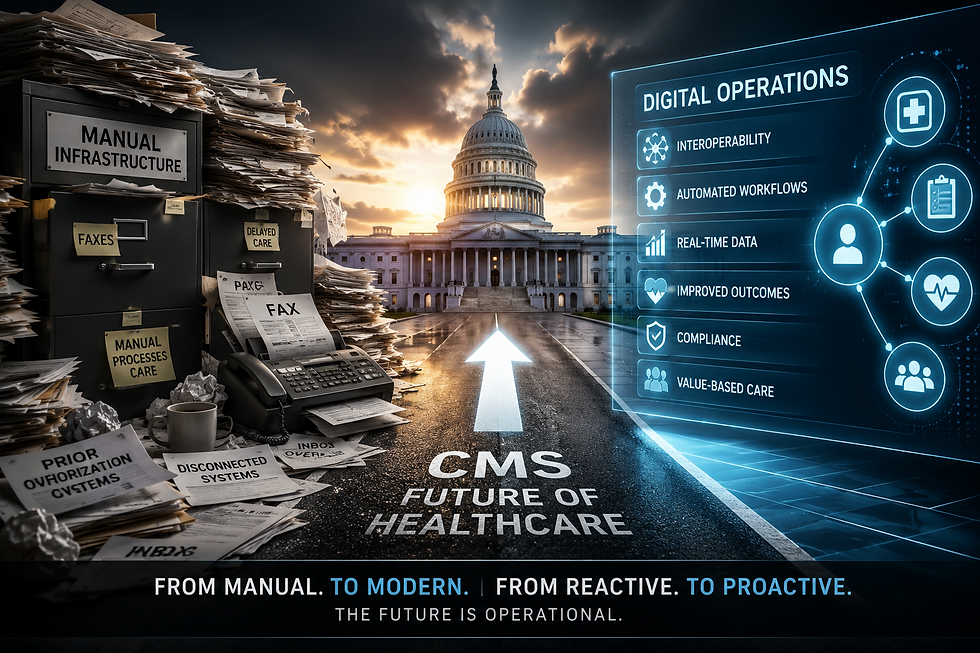
Advance Care Planning is the connective tissue.
ACP enables:
• Goal-concordant utilization
• Reduced unwanted interventions
• Earlier identification of misalignment
• Fewer avoidable hospitalizations
CMS is not introducing this because it is ethically appealing. It is doing so because it is economically necessary.
The ROI Case Is No Longer Theoretical
The evidence base for ACP is mature.
High-quality ACP is associated with:
• Reduced hospitalizations and ICU use
• Lower end-of-life spending
• Higher patient and family satisfaction
• Improved clinician confidence in decision-making
CMS has validated these outcomes across multiple studies and populations.
That is why ACP is no longer being tested in isolation. It is being scaled system-wide.
Why Most Organizations Are Not Ready
Despite years of discussion, most organizations still struggle to operationalize ACP effectively.
Common failure points include:
• ACP documentation living in free-text notes
• Preferences captured once and never updated
• Information siloed inside a single EHR
• No visibility during transitions of care
• HCBS and senior living data excluded entirely
CMS is now assuming these problems are solved.
They are not.
The Hidden Risk for Executives
The biggest risk is not failing to document ACP.
The risk is documenting it without making it operational.
If ACP exists but:
• Is not visible at admission
• Is not available during escalation
• Does not inform utilization decisions
• Does not follow the patient across settings
Then organizations will fail the spirit of the measure, even if they technically pass audits.
CMS is designing measures that reward alignment, not paperwork.
Why HCBS and LTSS Matter More Than Ever
The MUC list implicitly elevates HCBS and LTSS, even when those settings are not explicitly named.
Why?
Because:
• Preferences change first outside the hospital
• Early risk surfaces in community settings
• Fragmentation appears before acute escalation
If ACP is not updated and shared in these environments, downstream care will be misaligned by default.
CMS is building a system that assumes early visibility. That assumption is new.
What Leaders Should Be Doing Now
This is not a “wait for final rule” moment.
Executive teams should be asking:
• Where does ACP live today?
• How often is it updated?
• Who can see it at critical moments?
• Does it follow patients across transitions?
• Is it integrated into care planning and utilization workflows?
If the answer to any of these is unclear, the organization is not prepared.
Advance Care Planning as a Longitudinal Capability
The key reframing is this:
Advance Care Planning is no longer a document.
It is a capability.
A longitudinal ACP capability requires:
• Structured, portable data
• Workflow integration across settings
• Visibility at decision points
• Governance and accountability
CMS is now designing measures as if this capability already exists.
How This Connects to ACCESS, LEAD, and MAHA ELEVATE
These MUC measures are not standalone.
They align directly with:
• ACCESS model expectations around whole-person care
• LEAD’s long-horizon accountability
• MAHA ELEVATE’s focus on lifestyle, wellness, and goals
ACP serves as the anchor that enables these models to function as designed.
Without it, organizations will experience friction, leakage, and burnout.
The Bottom Line
The 2025 CMS Measures Under Consideration list is a roadmap hiding in plain sight.
Advance Care Planning appearing across fifteen programs is CMS telling the market:
We expect care to be anticipatory, goal-aligned, and coordinated across settings.
We will measure it.
We will pay for it.
And we will penalize fragmentation.
Organizations that treat this as a reporting exercise will struggle.
Organizations that build ACP as a longitudinal operating capability will not only comply. They will outperform. The question for leadership is no longer whether ACP matters. It is whether your organization can make it real.


Comments