
CMS Care Coordination Why Payment Signals, Administrative Reality, and Care Orchestration Must Converge

Over the weeks since CMS released its most cohesive signal yet about the future of care delivery, the industry response has been revealing.
Executives, clinicians, and policy observers broadly agree on the direction. Longitudinal accountability. Team-based care. Integration of behavioral, social, and lifestyle drivers. Data liquidity as a baseline expectation.
Where the conversation has sharpened is around execution.
At its core, this moment is a test of CMS care coordination. The policy direction is clear, but many organizations lack the operational infrastructure required to coordinate care across settings, time horizons, and accountability domains at the level CMS now assumes.
In particular, growing concern has emerged that the primary care and coordination payments embedded in current CMS models are not sufficient to support the level of referral management, cross-setting coordination, documentation, and auditability that CMS now implicitly requires.
This is not a philosophical disagreement with value-based care. It is an operational reality check. CMS has raised the bar on accountability faster than it has subsidized the infrastructure required to meet it.
That gap is now the defining risk and opportunity of ACCESS, LEAD, and MAHA ELEVATE.

CMS Care Coordination - Infrastructure is the Bottleneck
CMS is clear about what it expects.
Care must follow patients across settings, time horizons, and domains. Referrals must be closed loop. Outcomes must be attributable. Social and behavioral interventions must be measurable. Data must be portable and auditable.
What CMS has not done is fully re-architect the economics of coordination itself.
Primary care coordination payments and referral management compensation remain modest relative to the actual workload required to operationalize these models. The result is a paradox many organizations now feel acutely.
CMS expects longitudinal population oversight, active referral tracking, multidisciplinary collaboration, and real-time reporting tied to equity and outcomes.
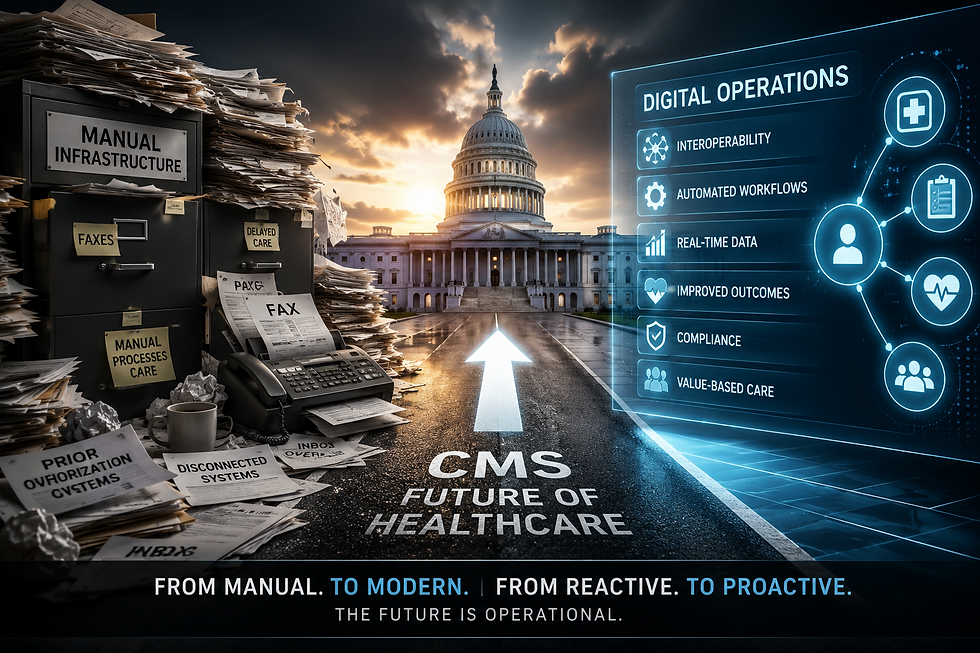
Many organizations are still operating with fragmented tools, manual workflows, siloed teams, and staff absorbing coordination labor without leverage.
This is why the conversation has shifted from policy optimism to execution anxiety.
Why More Payment Alone Will Not Solve This
Some have argued that CMS needs to pay more for coordination. That may be necessary. It will not be sufficient. Even materially higher coordination payments will not fix workflows that are fragmented by design. Adding dollars to a broken operating model increases cost without reliably improving outcomes.
The deeper issue is structural. CMS is no longer paying for individual acts of coordination. It is paying for the existence of a coordinated system.
That distinction matters.
ACCESS, LEAD, and MAHA ELEVATE are not asking whether a referral was made or a visit occurred. They are asking whether the organization can continuously manage risk, engagement, adherence, and outcomes across time.
That requires orchestration, not heroics.
Administrative Burden Is the Canary in the Coal Mine
Recent pushback around AI-enabled prior authorization pilots illustrates this clearly. The concern is not automation itself. Most clinicians welcome relief from administrative burden. The problem is automation layered onto already fragmented workflows, without transparency, explainability, or integration into the clinical context. This is the same failure mode that has plagued care coordination for years.
When coordination depends on manual follow-ups, disconnected portals, human memory, and post-hoc documentation, administrative burden rises faster than reimbursement. Burnout follows. Trust erodes. CMS is not endorsing black-box automation or brittle workflows. It is signaling that speed, auditability, and context must coexist. Organizations that treat AI and coordination as bolt-ons will struggle. Those that embed them into governed, longitudinal workflows will compound advantage.
LEAD and the End of Short-Term Optimization
The LEAD model makes this explicit.
With accountability horizons extending toward a decade, CMS is rewarding organizations that invest in durable operating infrastructure rather than annual optimization.
This changes the math.
Manual coordination might survive a one-year pilot. It collapses under ten-year accountability.
LEAD assumes stable care teams, persistent data continuity, long-lived care plans, and governance that survives leadership turnover. This is not compatible with tool sprawl or episodic engagement strategies. Boards should interpret LEAD as a signal that care orchestration is now a balance sheet decision, not a departmental one.
MAHA ELEVATE Raises the Stakes Further
MAHA ELEVATE expands accountability into domains most organizations have never operationalized at scale.
Lifestyle. Nutrition. Mental health. Functional status. Social context.
The challenge is not philosophical alignment. Many organizations already believe in whole-person care. The challenge is measurement and coordination. Without a shared operational layer that connects patients, families, care teams, and data systems, MAHA ELEVATE risks becoming another well-intentioned pilot that cannot produce defensible evidence at scale.
CMS is clear about the direction. The execution burden now rests with care organizations.
What This Means for Leaders Now
The emerging lesson from the past several weeks is not that CMS is confused. It is that CMS is intentionally forcing a separation between organizations that can operate as systems and those that cannot.
The winners will not be those who chase individual models.
They will be those who treat coordination as infrastructure, reduce staff time spent on manual handoffs, create shared visibility across patients, families, and care teams, and embed governance into automation rather than layering it on later.
This is where orchestration platforms become decisive.
CareAlly exists to serve as the coordination layer CMS now assumes. It connects clinical workflows, operational systems, and accountability requirements without pushing complexity onto frontline staff.
AgeWell extends that orchestration to residents and families, creating a shared source of truth for engagement, tasks, and care artifacts across settings and over time.
Together, they address the exact gap CMS has exposed. Not by promising more technology, but by reducing friction, compressing coordination time, and making longitudinal accountability operationally viable.
Key Takeaways
CMS is standardizing expectations for longitudinal, coordinated care across clinical, behavioral, and social domains.
Current coordination and primary care payments do not fully subsidize the operational infrastructure required to meet these expectations at scale.
Administrative burden and workflow friction are early indicators of misalignment between policy intent and execution reality.
Care orchestration, not additional point solutions, is the missing layer needed to operationalize accountability under ACCESS, LEAD, and MAHA ELEVATE.
Organizations that invest now in integrated coordination infrastructure will outperform under long-horizon value-based models.
Conclusion
The CMS Digital Health Roadmap reflects a decisive shift from fragmented innovation to integrated accountability. CMS is no longer asking whether technology can improve care. It is designing a system that assumes it must. For organizations willing to adapt, the opportunity is substantial. Reduced avoidable utilization, improved outcomes, and more predictable performance under value-based contracts are within reach. For those who delay, the risk is equally real. Rising administrative burden, staff burnout, and eroding margins will follow.
The roadmap is clear. The question for leaders is whether their organizations are prepared to operate within it.


Comments