
What Will 2026 Bring for Care Coordination Infrastructure?

In 2026, healthcare leaders will not be asking whether coordination matters. That question has already been answered.
The more relevant question is whether existing operating models can support the level of coordination that CMS, payers, and patients are beginning to assume as a baseline.
Over the past several years, virtual care, analytics, and automation moved from pilot projects into routine use. What changes in 2026 is not adoption, but expectation. Longitudinal accountability, cross-setting continuity, and auditable follow-through are increasingly treated as default capabilities rather than aspirational goals.
This shift places care coordination infrastructure squarely in the foreground, not as a clinical philosophy, but as an operating requirement.

A Look Back: From Tools to Systems
Point solutions dominated the early 2020s. Telehealth platforms. Remote monitoring tools. Care management applications. Each addressed a narrow problem, often effectively, but rarely together. That fragmentation was tolerable when coordination expectations were modest. By 2026, it will become a constraint.
Organizations are no longer evaluated on whether they have technology, but on whether their systems can carry decisions forward over time and across settings. Data must persist beyond individual encounters. Responsibilities must be visible. Actions must be traceable.
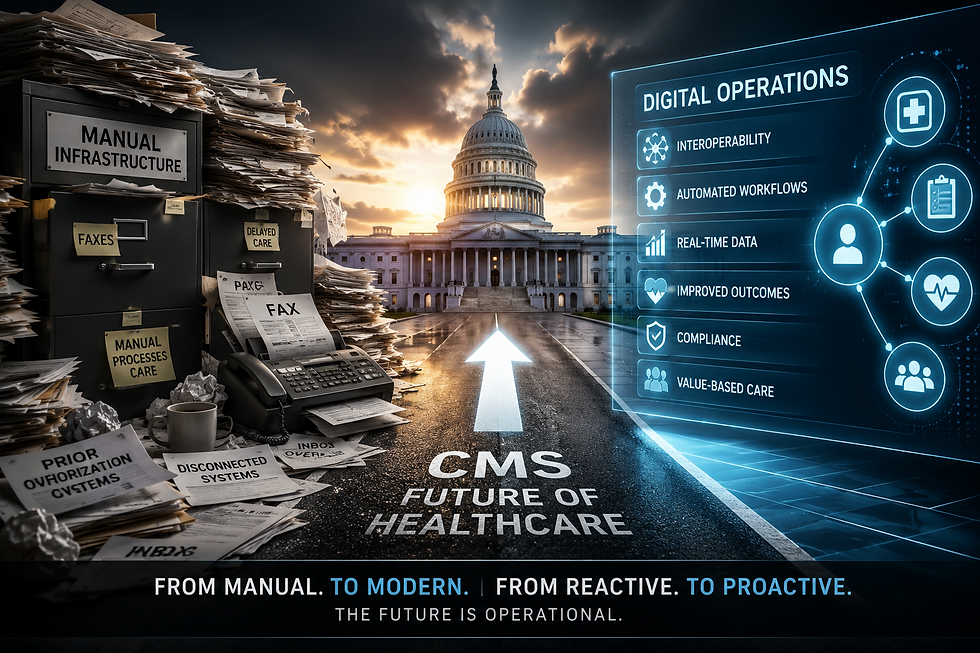
This marks a transition from software as a collection of tools to software as an operating layer.
The systems that matter going forward do not just surface information. They orchestrate work. They route tasks, manage handoffs, and ensure follow-through. They reduce reliance on memory, inboxes, and heroics.
This is the practical evolution of care coordination infrastructure.
The Economic Signals Heading Into 2026
The payment environment entering 2026 is not ambiguous.
Across Medicare and Medicaid models, nominal rate updates are increasingly paired with explicit or implicit productivity assumptions. Value-based purchasing programs continue to broaden their scope. Documentation accuracy remains unforgiving. Avoidable utilization is still one of the clearest financial penalties in the system.
The signal is consistent. Payment is tied less to isolated services and more to whether care is coordinated reliably over time.
Facilities and organizations that depend on manual tracking, disconnected documentation, and reactive workflows will feel margin pressure regardless of effort or intent. This is not a question of clinical commitment. It is a question of operating leverage.
Readmissions, preventable ED utilization, and delayed interventions remain expensive because they are coordination failures as much as clinical ones.
How ACCESS, LEAD, and MAHA ELEVATE Change the Coordination Bar
The clearest indicators of where coordination expectations are heading come from CMS’s newer models: ACCESS, LEAD, and MAHA ELEVATE.
These models differ in structure and population focus, but they converge on a common assumption. Coordination is no longer an adjunct function. It is the mechanism through which accountability is enforced.
ACCESS: Coordination That Has to Hold Over Time
ACCESS formalizes a shift that has been building for years. Responsibility for outcomes follows the individual across settings and over longer horizons.
Operationally, this exposes fragility.
Missed follow-ups, unclosed referrals, and loss of visibility after discharge are no longer workflow annoyances. They become sources of financial and quality risk.
Under ACCESS, episodic coordination breaks down. What is required instead is care coordination infrastructure that can:
• Carry care plans across encounters
• Track ownership through transitions
• Surface unresolved risks early
• Produce auditable evidence of outreach and intervention
This level of durability cannot be achieved solely through staffing.
LEAD: Making Behavioral and Social Drivers Executable
LEAD elevates behavioral health, social drivers, and lifestyle factors from documentation to execution. Many organizations can assess social needs. Far fewer can reliably act on them. Referrals are made, but follow-through is inconsistent. Feedback loops are weak. Outcomes are rarely visible. LEAD exposes this gap.
Performing under LEAD requires care coordination infrastructure that supports:
• Closed-loop referral management
• Longitudinal tracking of engagement
• Integration of community-based services into care workflows
• Visibility into whether interventions actually occurred
Without this infrastructure, LEAD risks becoming administratively heavy without materially changing outcomes.
MAHA ELEVATE: Coordination at Medicaid Scale
MAHA ELEVATE extends these expectations into Medicaid populations, where complexity and fragmentation are highest. This model tests whether coordination can scale without linear cost.
Medicaid populations experience more transitions, more non-clinical barriers, and more frequent breakdowns between medical and community services. Manual coordination does not survive this level of volume and variability.
Here, care coordination infrastructure must support:
• High-frequency touchpoints without proportional staffing increases
• Cross-agency visibility into services delivered
• Rapid identification of disengagement or deterioration
• Inclusion of families and caregivers as part of the execution layer
The organizations that perform well will not be those that add programs, but those that reduce friction.
Care Coordination Infrastructure Becomes the Scarce Asset
Historically, healthcare treated coordination as a staffing function. Care managers, discharge planners, and social workers are working valiantly inside fragmented systems. That model does not scale into 2026.
Coordination increasingly needs to function as infrastructure. Decisions must be durable. Tasks must persist. Accountability must survive handoffs. This is where many organizations struggle. Data exists, but it is not operationalized. Signals arrive late. Ownership is unclear.
Technology that adds alerts worsens the problem. What is needed are systems that route work, track completion, and escalate exceptions. This is not about removing humans from care. It is about preserving their attention for judgment rather than logistics.
Workforce Pressure Is the Forcing Function
Any realistic prediction for 2026 must account for labor.
Staffing shortages across healthcare and senior care are structural. Burnout remains high. Turnover is destabilizing and expensive. In this environment, the value of AI is not novelty. It is cognitive relief.
Documentation, scheduling, authorizations, follow-ups, and coordination logistics consume enormous clinician time without improving outcomes. These are precisely the areas where automation and orchestration can create leverage.
The organizations that succeed will use care coordination infrastructure to protect clinical judgment, not replace it. Humans remain responsible for empathy and accountability. Systems handle repetition and execution.
The Home Becomes Part of the Care Model
Another critical shift entering 2026 is the growing clinical relevance of the home. Historically, care teams had little visibility into daily behaviors, environmental risks, or early functional decline.
That is changing.
Remote assessments, ambient signals, and in-home interactions are generating usable data. Changes in mobility, sleep, nutrition, and adherence can be detected earlier, often without requiring residents to change their behavior.
This data only matters when it is acted upon.
Organizations that can integrate home-based signals into their care coordination infrastructure will intervene earlier. Those who
cannot will continue to respond after deterioration has already occurred.
Interoperability Moves From Aspiration to Assumption
Interoperability has been discussed for years. What changes by 2026 is enforcement. As national exchange frameworks mature, data liquidity becomes assumed. Intelligent coordination cannot occur without timely access to discharge summaries, medication lists, and care plans.
Interoperability is no longer a differentiator. It is table stakes. Care coordination infrastructure that cannot ingest and act on external data will stall.
How Discovery and Trust Are Changing
Families are also changing how they find care.
Search behavior is shifting from keywords to conversational queries handled by generative systems. Organizations are surfaced based on credibility, clarity, and experience rather than marketing volume.
Trust becomes a differentiator.
As AI becomes embedded in operations, governance and explainability matter. Families and clinicians want to understand how decisions are made and when humans are involved.
Organizations that invest in transparent systems will stand apart.
Looking Ahead
By 2026, care coordination infrastructure will be treated less as a feature and more as a foundational operating capability.
Organizations that succeed will not be those that adopt the most tools. They will be those who quietly make coordination reliable across time, settings, and teams.
CMS models like ACCESS, LEAD, and MAHA ELEVATE are not introducing a new philosophy. They are enforcing execution.
The next phase of care will reward organizations that can orchestrate complexity without amplifying burden.
Not louder systems. More dependable ones.


Comments