
CMS Is No Longer Tolerating Manual Infrastructure

Healthcare built digital records. It never built digital operations
For more than two decades, healthcare has invested billions in digitizing clinical records.
EHR adoption expanded. Patient portals launched. Claims systems modernized. Data warehouses grew.
But underneath the surface, most operational workflows never truly changed.
Admissions still move through PDFs.
Prior authorizations still stall inside fragmented portals .
Nurse notes still become retrospective documentation exercises.
Care coordination still depends on humans manually routing information between disconnected systems.
Healthcare digitized storage.
It did not digitize execution.
That distinction is becoming economically dangerous.
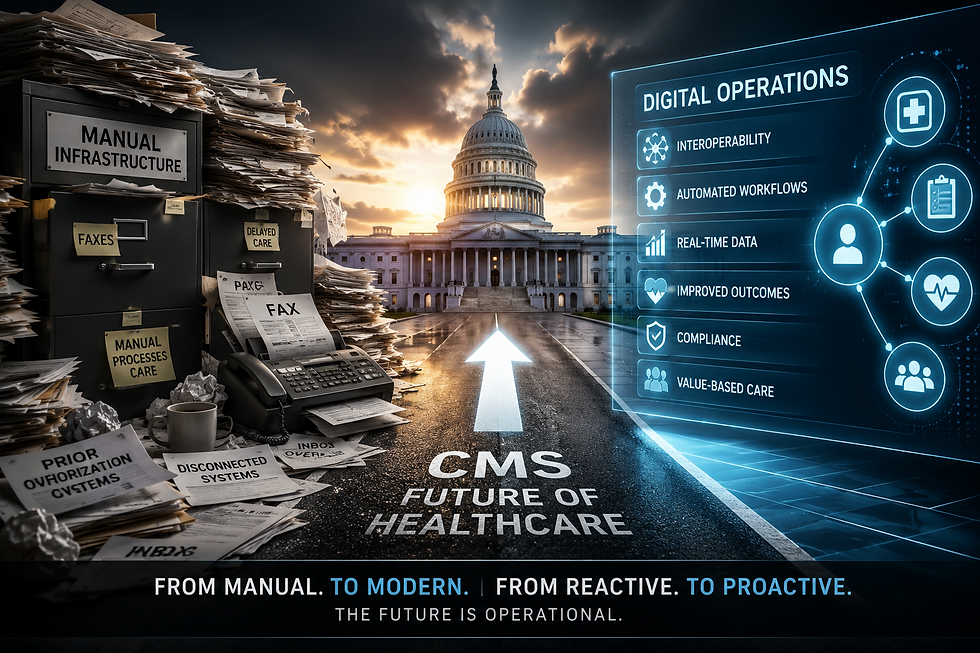
CMS Is No Longer Tolerating Manual Infrastructure Across Healthcare Operations
For years, healthcare organizations survived operational inefficiency because reimbursement models tolerated delay.
If documentation eventually arrived, the system still functioned. If coding was corrected retrospectively, reimbursement still flowed. If care coordination happened manually, organizations absorbed the staffing burden.
That environment is changing rapidly. CMS is no Longer Tolerating Manual Infrastructure
CMS initiatives are now compressing operational decision windows across the healthcare system:
• Electronic prior authorization mandates
• Digital quality reporting requirements
• CMS ACCESS interoperability initiatives• Increasing CAHPS and HOS weighting
• Encounter integrity enforcement• Trajectory based value-based care measurement
• Real-time data exchange expectations
These changes are not isolated regulatory updates.
They are signals that healthcare reimbursement is shifting from retrospective reconciliation to real-time operational accountability.
That shift fundamentally changes the economics of manual infrastructure.
Manual Infrastructure Was Hidden by Labor
Most healthcare organizations still operate through invisible human routing layers.
A nurse downloads a PDF. A coordinator rekeys data into another system. A case manager manually checks eligibility. An admissions packet sits in an inbox, waiting for review. A denial requires staff to assemble documentation from five disconnected systems.
The industry normalized these workflows because labor compensated for broken infrastructure.
But labor is no longer cheap enough. Margins are no longer wide enough. Decision windows are no longer long enough.
What previously looked like “workflow friction” is becoming direct financial risk.
Organizations are now discovering that operational fragmentation impacts:
• hospital readmissions
• prior authorization turnaround time
• STAR performance
• CAHPS performance
• denial rates
• admissions conversion
• encounter accuracy
• value-based care outcomes
The operational layer is no longer administrative overhead.
It is becoming the reimbursement engine itself.
Digital Records Without Operational Orchestration Are No Longer Enough
Many healthcare organizations believe interoperability alone solves this problem.
It does not.
Moving data between systems is only the first step. The larger challenge is operational orchestration.
Who receives the information? What workflow activates? What action becomes required? What escalation occurs? What audit trail exists? What intervention happens before deterioration occurs?
These are operational questions, not documentation questions.
The organizations creating advantage right now are not simply collecting more data.
They are building systems capable of acting on information in real time across fragmented workflows.
That is the real infrastructure transition now underway.
Value-Based Care Is Accelerating the Collapse of Retrospective Operations
This pressure becomes even more severe under value-based care models.
Historically, reimbursement rewarded documentation completeness.
Increasingly, reimbursement is beginning to measure longitudinal outcomes and operational responsiveness instead.
That changes everything.
Healthcare organizations can no longer depend entirely on retrospective chart review to protect margins.
They now need:
• continuous visibility
• operational coordination• proactive intervention
• governed workflow execution
• real-time clinical and administrative signal detection
The economic model is shifting from: “Was the event documented?”
to: “Did the organization operationally prevent deterioration?”
That is a completely different infrastructure requirement.
The Next Healthcare Divide Will Be Operational
The next major divide in healthcare will not simply be between organizations that adopted AI and those that did not.
It will be between organizations that have modernized their operational infrastructure and those still dependent on manual routing layers.
Because the future healthcare battleground is no longer just clinical documentation.
It is execution speed. Workflow coordination.Operational visibility.And the ability to act before financial or clinical deterioration occurs.
CMS is signaling this clearly.
The organizations listening now will have time to adapt.
The organizations waiting for full economic pain to arrive may discover the infrastructure transition is already too far underway.


Comments