
The Cross-Setting Care Breakdown in Healthcare Is Where Margin Is Lost

FocKeyword Phrase: cross-setting care breakdown in healthcare
There is a structural problem in healthcare that has been discussed for years, acknowledged by every operator, and still largely unresolved.
The cross-setting care breakdown in healthcare. It is not new. But it is becoming financially unavoidable.
As payment models shift toward value-based care, and as CMS continues to tighten expectations around outcomes, trajectory, and accountability, the gaps between settings are no longer operational inconveniences. They are direct drivers of revenue loss, avoidable utilization, and audit exposure.
Most organizations are still not built to manage care across settings in a coordinated, accountable way.
And that is now where the system is being tested.

The Illusion of Continuity
Healthcare systems often operate under the assumption that care is continuous.
In reality, it is fragmented.
A patient transitions from the hospital to skilled nursing care. From skilled nursing to home health.From home health back to primary care or the emergency department.
At each transition, information is handed off. But accountability is not.
Each setting documents its portion of the encounter. Each team focuses on its immediate responsibility. And the system assumes that continuity will emerge from documentation alone.
It does not.
The cross-setting care breakdown in healthcare occurs precisely at these transition points.
Critical information is delayed, incomplete, or never reviewed. Clinical context is lost . Care plans are not operationalized across teams. And early signs of deterioration are missed.
By the time the issue becomes visible again, it often presents as utilization.
A readmission.An emergency department visit.A complication that could have been prevented.
Why This Did Not Break the System Before
For years, healthcare economics allowed this fragmentation to persist.
Payment was tied to documented activity. If the condition was coded correctly and the encounter was supported, revenue could be defended.
The system did not require proof that the patient’s condition improved over time.
It did not require visibility across settings.
It did not require organizations to operationalize the full clinical story.
So the cross-setting care breakdown in healthcare remained an operational problem, not a financial one.
That distinction no longer holds.
The Shift to Accountability Across Time
Emerging models tied to value-based care are introducing a different expectation.
Not just: Was the condition documented?
But: Did the patient improve?Did the resident stabilize?Did the care plan actually work over time?
This is a fundamentally different question.
It requires:
Longitudinal visibility into condition progression
Coordination across multiple care settings
Defined intervention points when trajectory changes
Accountability for outcomes, not just encounters
The cross-setting care breakdown in healthcare directly undermines all of this.
If information does not move cleanly between settings, trajectory cannot be tracked.
If the trajectory cannot be tracked, the intervention cannot be timed.
If intervention is not timely, utilization increases.
And when utilization increases, margin disappears.
Where the Breakdown Actually Happens
It is easy to describe the problem at a high level.
It is more useful to identify where it actually occurs operationally.
1. Hospital to Skilled Nursing Transition
This is one of the most critical and most fragile handoffs in the system.
The skilled nursing facility often receives:
Incomplete discharge summaries
Delayed documentation
Limited insight into the patient’s recent trajectory
Admissions teams are forced to make decisions quickly, often without full clinical context.
Care plans are built on partial information. Early deterioration signals are easy to miss because baseline is unclear.
This is where the cross-setting care breakdown in healthcare first compounds risk.
2. Skilled Nursing to Home or Community
As residents transition out of skilled nursing, continuity becomes even more difficult.
Care coordination relies heavily on:
Discharge instructions
Follow-up scheduling
Patient or family adherence
There is limited real-time visibility into whether the plan is actually being executed.
There is even less visibility into whether the patient’s condition is improving.
Without structured follow-up and monitoring, deterioration often goes undetected until it escalates.
3. Primary Care and Specialist Fragmentation
Even within outpatient settings, coordination challenges persist.
Different providers operate in different systems.
Documentation is siloed.
Communication is asynchronous.
The result is a fragmented clinical narrative.
No single entity owns the full trajectory.
This is a core component of the cross-setting care breakdown in healthcare.
The Financial Consequences Are Now Direct
Historically, these breakdowns resulted in inefficiency.
Now they result in a measurable financial impact.
Avoidable Utilization
When deterioration is not identified early, it becomes acute.
Emergency department visits increase. Readmissions increase. Length of stay extends.
Each of these carries direct cost implications.
Denials and Audit Exposure
As payment accuracy becomes a priority, documentation is no longer sufficient on its own.
Payers are asking:
Does the clinical story make sense across time? Does the documentation align with actual outcomes?
When the cross-setting care breakdown in healthcare disrupts that story, organizations are forced into reactive defense.
Manual chart reconstruction.Appeals processes.Delayed cash flow.
Margin Compression
The combination of increased utilization and increased administrative burden creates a predictable outcome.
Margin erosion. Not because care was not delivered.But because it was not coordinated, tracked, or defensible.
Why Technology Alone Has Not Solved This
Many organizations have invested heavily in technology.
EHRs.Data exchanges.Integration layers.
Yet the cross-setting care breakdown in healthcare persists.
Why?
Because the problem is not just data availability.
It is operational design.
Most systems:
Store information but do not synthesize it
Capture events but do not track trajectory
Document care but do not drive action
Without a layer that connects data to workflow, visibility does not translate into outcomes.
What Needs to Change
Addressing the cross-setting care breakdown in healthcare requires a different approach.
Not incremental improvement.
Structural change.
1. From Documentation to Trajectory
Organizations must shift from viewing care as a series of encounters to viewing it as a continuous trajectory.
This means:
Tracking condition changes over time
Establishing expected progression paths
Identifying deviations early
2. From Visibility to Action
Seeing deterioration is not enough.
There must be:
Defined intervention points
Assigned ownership for next steps
Closed-loop workflows to confirm action
Without this, visibility becomes passive observation.
3. From Siloed Systems to Orchestrated Workflows
Data must move across settings.
But more importantly, workflows must extend across settings.
This includes:
Admissions processes that incorporate prior context
Discharge processes that trigger follow-up actions
Ongoing monitoring that feeds back into care decisions
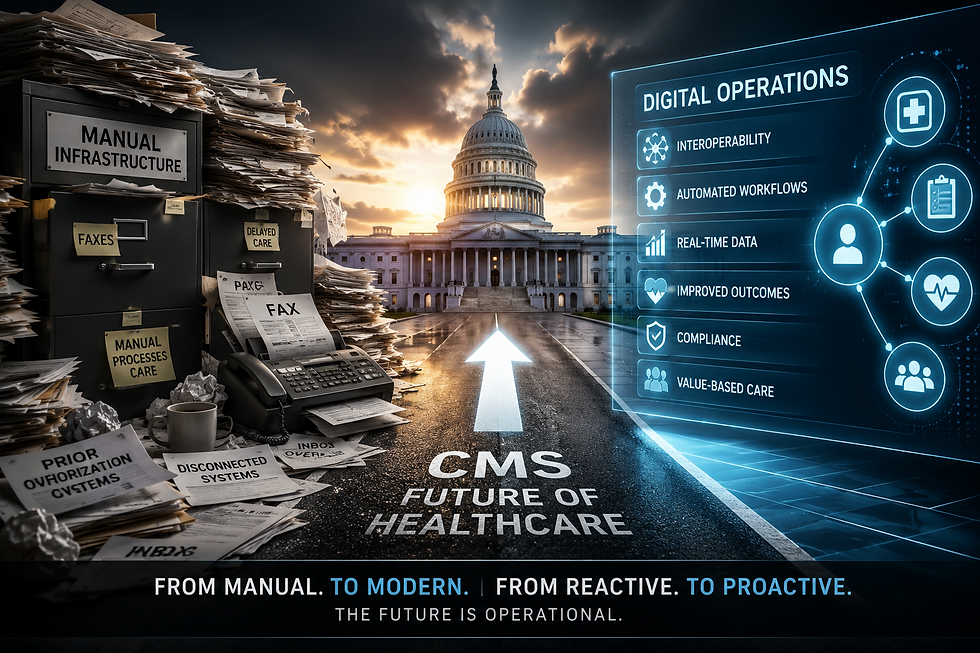
4. From Reactive to Proactive Operations
Most organizations still operate reactively.
Responding to events after they occur.
The future requires:
Anticipation of risk
Early intervention
Continuous adjustment of care plans
The Organizations That Will Win
The cross-setting care breakdown in healthcare will not impact all organizations equally.
Those who address it will gain a structural advantage.
They will be able to:
Reduce avoidable hospital visits
Improve outcomes for residents and patients
Defend revenue with a coherent clinical narrative
Lower administrative burden through proactive workflows
They will operate with clarity where others operate with fragmentation.
The Reality of Where the Market Is Going
This is not a future state.
It is already underway.
CMS is pushing toward models that require:
Continuous eligibility and alignment tracking
Ongoing reporting of outcomes
Accountability across the care continuum
Star Ratings and other quality programs are shifting toward experience and outcomes.
Payment accuracy initiatives are increasing scrutiny on documentation.
All of these trends converge on a single point.
The cross-setting care breakdown in healthcare is no longer tolerable.
Final Thought
For years, healthcare organizations could succeed despite fragmentation.
That window is closing.
The question is no longer whether care was delivered and documented.
It is whether the outcome can be demonstrated across time and across settings. And whether the organization can act on that information before it becomes a cost.
The cross-setting care breakdown in healthcare is where that battle is won or lost.
Organizations that continue to operate in silos will find themselves increasingly reactive, increasingly exposed, and increasingly constrained.
Those who build the ability to see, act, and prove across settings will not just adapt.
They will define the next operating model of healthcare.


Comments